Kolektor Mobility
 Kolektor Technologies
 Kolektor Construction


Kolektor Mobility once again takes part in the EMC Student Challenge
26. 10. 2026
How do you design an electronic circuit that is not only functional and efficient, but also meets demanding electromagnetic compatibility requirements while remaining cost-effective? This was the challenge students faced this year as part of the ninth Electronics Design for EMC 2026 competition.
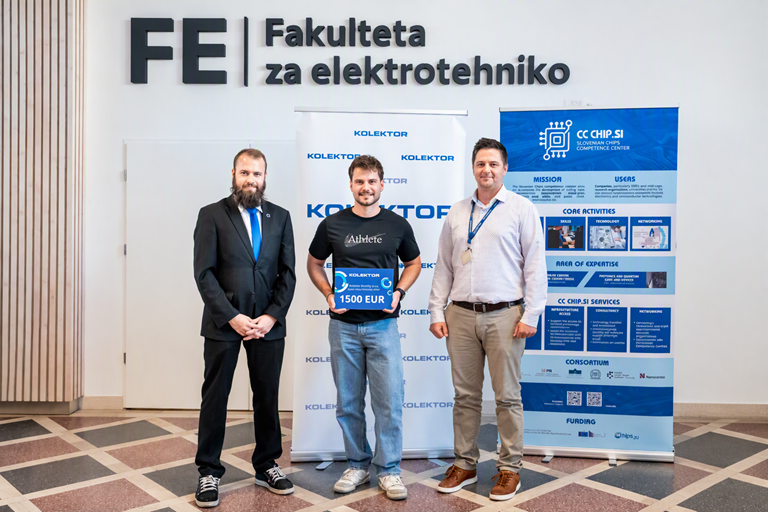
From left: Luka Kavčič from Product Validation, competition winner Tilen Plahuta, and Jaka Ivančič, Deputy Head of Hardware Engineering.
Electromagnetic compatibility (EMC) is one of the key challenges in the development of modern electronic devices, as it must be considered throughout the entire development process, from the initial concept to final product testing. One of the key strengths of the competition is its close connection with industry. Industrial partners introduce students to real-world development challenges, provide expert support and materials, and create an environment where theoretical knowledge meets real-world engineering problems.
Where theory meets practice
Kolektor Mobility set a demanding engineering challenge: to design and build a power driver for a brushless electric motor while meeting the specified electrical, thermal, safety and EMC requirements.
In addition to technical performance, the cost-effectiveness of the solution was also an important consideration. The best design therefore had to strike the right balance between performance, energy efficiency, electromagnetic emissions and component costs.
The competition began with a six-week programme of lectures and demonstrations delivered by industry experts. This year, the programme was further enhanced by a four-week workshop on electromagnetic simulations using Ansys tools, delivered by Simtec.
Luka Kavčič and Jaka Ivančič designed Kolektor’s engineering challenge, helped the students at workshops and conducted the final measurements.
From an idea to a working product
Interest in this year’s challenge was strong. 109 students registered, 16 submitted their electronic circuit designs, and nine successfully completed the entire development process and presented working products.
This journey from an idea to a working product is one of the most valuable aspects of the competition. Participants have to put their theoretical knowledge into practice, build and test an actual device, work within practical constraints, and solve the many challenges that arise during development and testing in a real-world engineering environment.
The best balance between performance, efficiency and cost
This year’s winner was Tilen Plahuta, whose solution achieved the best overall balance across all evaluation criteria. His circuit ranked highest in functionality, efficiency, thermal performance and component cost, while achieving second place in conducted and radiated electromagnetic interference measurements.
His result demonstrated that an outstanding engineering solution does not necessarily require the most expensive components. Instead, it comes from carefully balancing technical performance, efficiency and cost.
He also accompanied his project with a witty slogan that perfectly captures the hands-on nature of engineering:
“EMC is still solved with a soldering iron, not with a prompt!”
For his outstanding achievement, he received Kolektor’s main prize of EUR 1,500.
By taking part in projects like this, we aim to bring young engineers closer to real-world development challenges and give them the opportunity to put their knowledge to the test where it matters most: developing solutions that work beyond the classroom.
Back